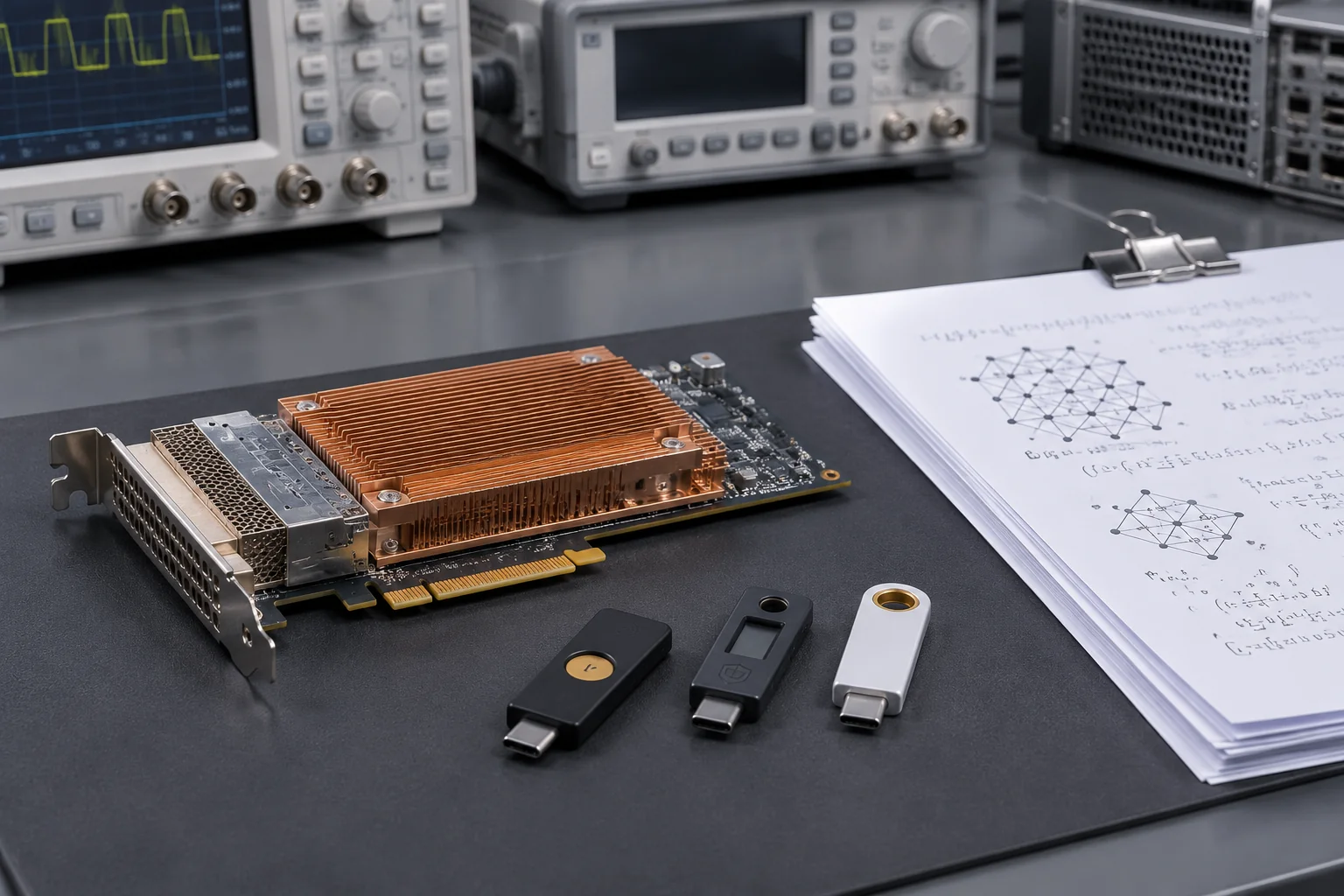
1. Threat Asymmetry: Shor vs. Grover & the NIST IR 8547 Deprecation Clock
Post-quantum cryptography (PQC) replaces public-key primitives vulnerable to Shor's polynomial-time quantum period-finding algorithm (which factors RSA moduli and solves discrete logarithms over finite fields DH/DSA and elliptic curves ECDH/ECDSA/Ed25519/secp256k1 on a fault-tolerant quantum computer) with mathematical problems resistant to both classical and quantum algorithms, executed entirely on ordinary classical silicon today.
Understanding migration urgency requires separating three completely different cryptographic lifespans:
- Ephemeral Session Confidentiality (
URGENT NOW): Any encrypted session recorded on backbone fiber today (TLS 1.3,SSH,IPsec/WireGuard,Signalmessages,ageencrypted backups) faces Harvest Now, Decrypt Later (HNDL) archival capture. Under Mosca's Theorem (X + Y > Z), if your secrets must remain confidential forXyears (for example,10years for medical, financial, source-protection, or legal archives) and full infrastructure migration takesYyears (3to5years), migration must finish beforeZ(time to a cryptanalytically relevant quantum computer). - Online Authentication & Ephemeral Signatures (
2026-2030 WINDOW): An attacker cannot use a future2034quantum computer to travel backward in time and forge aTLS 1.3handshake signature that a browser already verified and closed in2026. However, long-lived trust anchors (root Certificate Authorities valid until2040, hardware firmware boot-ROM verification keys in Secure Elements, and OS OTA signing roots) must embed post-quantum or hash-based signature verification now because field hardware cannot swap mask-ROM public keys later. Under NIST IR 8547 and CNSA 2.0 federal schedules,112-bit classical asymmetric algorithms (RSA-2048,ECDSA P-256,Ed25519,X25519) are slated for deprecation by 2030 and full disallowance by 2035. - Public Blockchains & Static On-Chain Public Keys (
STRUCTURAL EXPOSURE): On Bitcoin and Ethereum, an address whose raw elliptic-curvesecp256k1public key has already been revealed on-chain (earlyP2PKcoinbase outputs holding roughly1.7M+BTC,TaprootP2TRscript/key-path outputs exposing a32-byte tweakedx-onlypubkey directly in the locking script, or anyP2PKH/P2WPKH/EVM address that has signed at least one outbound transaction) exposes its public key permanently in public ledger history for offline Shor key recovery unless migrated before CRQC arrival. Never reuse addresses on self-custody wallets.
2. The Complete NIST Post-Quantum Portfolio (FIPS 203, 204, 205, 206 & HQC)
In August 2024, NIST published the world's first three finalized Federal Information Processing Standards for post-quantum cryptography, followed in March 2025 by selecting HQC as the fifth standardized algorithm to diversify mathematical assumptions beyond lattices:
2.1 FIPS 203 (ML-KEM, derived from CRYSTALS-Kyber)
NIST FIPS 203 standardizes the Module-Lattice-Based Key-Encapsulation Mechanism (ML-KEM) across three parameter sets (ML-KEM-512, ML-KEM-768, ML-KEM-1024), grounded in the hardness of solving Module Learning With Errors (MLWE) over polynomial rings R_q = Z_q[X]/(X^256 + 1) with prime modulus q = 3329.
- Key Finalization Diff vs. Kyber Round-3 Drafts: Final
FIPS 203removed public-key pre-hashing inside the encryption seed derivation and incorporated the encapsulator's hashed encapsulation keyH(ek)directly into the Fujisaki-Okamoto (FO) shared-secret derivation (K, r = G(m || H(ek))), strengthening multi-target and binding properties (meaning finalizedML-KEM-768is wire-incompatible with olderKyber768Draft00test deployments!). - Recommended Default:
ML-KEM-768(NIST Security Category 3, roughly matching or exceedingAES-192quantum search cost) is the universal industry default across TLS 1.3, OpenSSH, and file encryption, executing keygen + encaps + decaps in fewer CPU cycles than classicalX25519onAVX2andARMv8 NEONthanks to fast Number-Theoretic Transforms (NTT).
2.2 FIPS 204 (ML-DSA, derived from CRYSTALS-Dilithium)
NIST FIPS 204 specifies the primary general-purpose post-quantum digital signature standard (ML-DSA-44, ML-DSA-65, ML-DSA-87), based on Fiat-Shamir with Aborts over MLWE and Module Short Integer Solution (MSIS) lattices (q = 8,380,417).
- Final
FIPS 204defaults to hedged (randomized) signing (mixing32bytes of fresh CSPRNG randomnessrndwith message and private key material) to defend hardware devices against differential fault-analysis and power side-channel attacks, alongside domain-separated context strings (ctxup to255bytes) and aHashML-DSApre-hash profile for constrained streaming signers. - Wire-Size Reality: Whereas an
Ed25519public key is32bytes and its signature is64bytes,ML-DSA-65requires a1,952-byte public key and a3,309-byte signature. A standard 3-certificate TLS X.509 chain signed with pureML-DSA-65adds roughly15.8 KBto a handshake: exceeding TCP's10-segment initial congestion window (~14.6 KB) unless paired with TLS Certificate Compression (RFC 8879Brotli/Zstd) or emerging IETF Merkle Tree Certificates (MTC).
2.3 FIPS 205 (SLH-DSA, derived from SPHINCS+) & Draft FIPS 206 (FN-DSA / Falcon)
FIPS 205(SLH-DSA): A stateless hash-based signature scheme (12parameter sets acrossSHA2andSHAKE, each offered inssmall-signature orffast-signing variants). Its security relies exclusively on cryptographic hash function properties (preimageandsecond-preimageresistance ofSHA-256/SHA-512/SHAKE256): zero lattices, zero number theory! Public keys are tiny (32to64bytes), makingSLH-DSAthe ultimate conservative choice for root CAs, OS bootloaders, and hardware wallet firmware signing where7,856-byte to49,856-byte signatures and slower signing times (milliseconds to tens of milliseconds) are completely acceptable. (Note: unlike statefulXMSS/LMS[NIST SP 800-208],SLH-DSAis stateless and cannot catastrophically leak private keys if a VM snapshot rolls back a signing counter.)- Draft
FIPS 206(FN-DSA, derived from Falcon): Built on NTRU lattices with Fast Fourier Sampling (FN-DSA-512andFN-DSA-1024), achieving compact signatures (666bytes at Level 1) + small public keys (897bytes) that fit comfortably inside single UDP/DNSSEC packets, at the engineering cost of complex constant-timeIEEE-75464-bit floating-point arithmetic during signing.
2.4 HQC (Hamming Quasi-Cyclic): NIST's 5th Standard & Code-Based KEM Insurance
In March 2025, NIST concluded Round 4 by selecting HQC as the standardized backup KEM to ML-KEM (see our primary dispatch in Security Advisories). HQC's security reduces to decoding random quasi-cyclic linear error-correcting codes in the Hamming metric (QC-SD Syndrome Decoding), providing an orthogonal mathematical fallback with predictable decryption failure rates (DFR < 2^-128), albeit with larger wire artifacts (2,249-byte public key and 4,481-byte ciphertext for HQC-128).
3. Master Byte-Budget & Cryptographic Comparison Table (2026)
| Algorithm & Standard | NIST Cat. | Hardness Assumption | Public Key (Bytes) | Ciphertext / Sig (Bytes) | Relative CPU & Primary Engineering Role |
|---|---|---|---|---|---|
| X25519 (Classical Baseline) | 0 (Shor broken) | Elliptic-Curve ECDLP (Curve25519) | 32 B | 32 B | Baseline classical ECDH; vulnerable to Harvest-Now-Decrypt-Later |
| ML-KEM-512 (FIPS 203) | Cat. 1 (~AES-128) | Module-LWE (k=2, q=3329) | 800 B | 768 B | Ultra-fast (faster than X25519 w/ AVX2); constrained IoT KEM |
| ML-KEM-768 (FIPS 203) | Cat. 3 (~AES-192) | Module-LWE (k=3, q=3329) | 1,184 B | 1,088 B | Global Recommended Default KEM (~0.04 ms handshake cost) |
| ML-KEM-1024 (FIPS 203) | Cat. 5 (~AES-256) | Module-LWE (k=4, q=3329) | 1,568 B | 1,568 B | CNSA 2.0 national-security profile & Signal PQXDH prekeys |
| X25519MLKEM768 (IETF Hybrid) | Cat. 3 + Classical | Dual: ECDLP AND Module-LWE | 1,216 B | 1,120 B | Production Standard in TLS 1.3 (0x11EC), OpenSSH & age |
| HQC-128 (NIST 5th PQC Selection) | Cat. 1 (~AES-128) | Quasi-Cyclic Code Decoding (Hamming) | 2,249 B | 4,481 B | Non-lattice mathematical backup KEM if algebraic lattices weaken |
| Ed25519 (Classical Baseline) | 0 (Shor broken) | Twisted Edwards ECDLP (SHA-512) | 32 B | 64 B | Compact classical signature; safe online short-term until CRQCs |
| ML-DSA-44 (FIPS 204) | Cat. 2 (~SHA-256) | Module-LWE + Module-SIS (4x4) | 1,312 B | 2,420 B | Fast lattice signature for WebPKI leaf certs & API tokens |
| ML-DSA-65 (FIPS 204) | Cat. 3 (~AES-192) | Module-LWE + Module-SIS (6x5) | 1,952 B | 3,309 B | Recommended Default General-Purpose PQ Signature |
| ML-DSA-87 (FIPS 204) | Cat. 5 (~AES-256) | Module-LWE + Module-SIS (8x7) | 2,592 B | 4,627 B | CNSA 2.0 high-assurance code/firmware & PKI root signing |
| FN-DSA-512 (Draft FIPS 206) | Cat. 1 (~AES-128) | NTRU Lattice (SIS w/ FFT sampling) | 897 B | 666 B | Smallest PQ pk + sig footprint (DNSSEC); tricky constant-time FPU |
| SLH-DSA-SHA2-128s (FIPS 205) | Cat. 1 (Hash-Only) | Pure SHA-256 Stateless Merkle/FORS | 32 B | 7,856 B | Slow sign (~50-150 ms), fast verify; ideal Root CA & OS Boot ROM |
4. Hybrid X25519MLKEM768 Handshake & Key-Combiner Architecture Diagram
0x11EC (X25519MLKEM768), adding roughly 2.27 KB total handshake payload while preserving 1-RTT latency.5. Production Migration Playbook Across Core Infrastructure
5.1 TLS 1.3 (X25519MLKEM768, Codepoint 0x11EC) & Middlebox Fragmentation
Early 2023-2024 TLS post-quantum trials encountered sporadic connection resets (~0.1% to 0.4% failure rate) from outdated corporate firewall Deep Packet Inspection (DPI) appliances whose parsers assumed a TLS ClientHello always fit inside a single 1,500-byte Ethernet frame (1,460-byte TCP MSS). When X25519MLKEM768 pushes ClientHello past 1,600 bytes across two TCP segments, broken stateful middleboxes hung waiting for single-packet SNI parsing.
Modern TLS stacks (BoringSSL, OpenSSL 3.5+, AWS-LC, rustls with aws-lc-rs, Chrome, Brave, Firefox, and Cloudflare edge) ship X25519MLKEM768 (0x11EC) enabled by default with happy-eyeballs fallback protection:
- Verify your own browser's negotiated
TLS 1.3post-quantum group right now via DT.gl's stateless Encrypted Transport Echo. - On origin servers running Nginx/HAProxy/Caddy with
OpenSSL 3.5+orBoringSSL, prioritizeX25519MLKEM768:X25519:P-256inssl_ecdh_curve/Groupsso modern clients negotiate hybrid PQ automatically while legacy IoT stacks cleanly negotiateX25519without extra round trips (providedX25519MLKEM768is offered first inkey_share).
5.2 OpenSSH (mlkem768x25519-sha256 vs. sntrup761x25519-sha512)
OpenSSH pioneered preemptive HNDL defense in 2022 by enabling [email protected] (Streamlined NTRU Prime + X25519), and starting in OpenSSH 9.9 / 10.x promoted mlkem768x25519-sha256 (FIPS 203 ML-KEM-768 + X25519) as the top-priority default Key Exchange (KexAlgorithms) algorithm! To harden Linux/BSD bastion hosts in /etc/ssh/sshd_config:
KexAlgorithms mlkem768x25519-sha256,sntrup761x25519-sha512,[email protected],curve25519-sha256
Ciphers [email protected],[email protected]
MACs [email protected],[email protected]
5.3 File & Backup Encryption: age Hybrid ML-KEM vs. OpenPGP (RFC 9580)
Cold backups uploaded to untrusted cloud object stores (S3, Backblaze B2, Arweave/IPFS) are the single highest-risk target for Harvest-Now-Decrypt-Later, because object-store buckets routinely leak decades later:
- Prefer
age(age-encryption.org) withmlkem768x25519Recipients: Designed by Filippo Valsorda and Ben Cox to eliminate OpenPGP's 30-year configuration footguns,agesupports native hybrid post-quantum recipients (age1pq1...combiningML-KEM-768+X25519viaHPKEX-Wingcombiner construction) alongside symmetricscryptpassphrases (test passphrase entropy offline in our Seed & Entropy Lab). - OpenPGP (
RFC 9580v6 + IETFdraft-ietf-openpgp-pqc): If workflows require PGP detached signing and mail integration, migrate legacyCFB-mode keys toRFC 9580AEAD (OCB) +draft-ietf-openpgp-pqccompositeML-KEM-768+X25519subkeys andML-DSA-65+Ed25519composite signing keys. - Messaging & VPNs: Pair encrypted backups with PQXDH/SPQR-enabled messengers and WireGuard post-quantum pre-shared keys (
Rosenpassor Mullvad PQ tunnels).
5.4 Side-Channel & Implementation Verification Checklist for Engineers
Before adopting any PQC crate or C library in production:
- Verify
FIPS 203Encapsulation Key Modulus Check (ekvalidation): Section 7.2 ofFIPS 203mandates checking that decoded12-bit polynomial coefficients inekre-encode identically (ByteEncode_12(ByteDecode_12(ek)) == ek, ensuring every integer strictly satisfies0 <= c < 3329) before encapsulation. Skipping this check breaks IND-CCA2 reductions. - Ban Variable-Time Integer Division Instructions (
DIV/UDIV): Confirm viactgrind/dudector formal assembly audit (libcruxformally verifiedF*/HaxRust/C ML-KEM oraws-lc) that polynomial Barrett/Montgomery reductions never emit secret-dependent CPU division instructions (KyberSlashclass). - Never Reuse
ML-KEMEphemeral Coins or Strip Implicit Rejection: InML-KEM.Decaps, invalid ciphertexts MUST return pseudorandom implicit-rejection outputJ(z || c)in strictly constant time (FO^{\not\perp}), never an early error branch (⊥), preventing Bleichenbacher-style chosen-ciphertext lattice key-recovery oracles.
6. WebPKI Certificate Bloat, Merkle Tree Certificates (MTC) & DNSSEC Wire Limits
While upgrading ephemeral TLS 1.3 key exchange to X25519MLKEM768 adds only 2,272 bytes across both directions and requires zero changes to Certificate Authorities, migrating WebPKI X.509 certificate chains and DNSSEC zone signatures presents a far steeper systems-engineering hurdle.
In a classical ECDSA P-256 or Ed25519 TLS handshake, a typical server transmits:
- One leaf
ServerCertificatepublic key (32to65bytes) + intermediate CA signature (64bytes); - One intermediate CA certificate public key (
32to65bytes) + Root CA signature (64bytes); - One handshake
CertificateVerifysignature (64bytes) +2or3Certificate Transparency (RFC 6962SCT) signatures (~192bytes).
Total classical authentication crypto inside the handshake is roughly 550 bytes. Replacing every one of those keys and signatures naively with ML-DSA-65 (1,952-byte public key + 3,309-byte signature) balloons authentication overhead to more than 20,000 bytes (2x leaf + intermediate public keys = 3,904 B, 3x cert + handshake signatures = 9,927 B, plus 2x PQ SCTs = 6,618 B). On congested cellular links with a 10-packet TCP initial congestion window (~14.6 KB), exceeding initcwnd forces an extra network round-trip stall on every cold HTTPS page load.
Two IETF architectural standards solve post-quantum PKI bloat without sacrificing security margins:
- Merkle Tree Certificates (
MTC, IETFplantsWorking Group): Instead of signing every individual domain certificate with a3,309-byteML-DSAor7,856-byteSLH-DSAsignature, the Certificate Authority batches millions of issued certificates into a periodic Merkle Tree whose root hash is co-signed by CAs and transparency monitors and pre-distributed to browsers via OS/browser trust-store updates. During aTLS 1.3handshake, the origin server omits intermediate CA certificates and SCT signatures altogether, transmitting only a compactSHA-256Merkle inclusion proof (~640to832bytes) plus a single leafCertificateVerifysignature. - Abridged Certs &
RFC 8879Certificate Compression: Pre-installing common PQ intermediate CA public keys inside browser binaries (Chrome Root Store/Mozilla NSS) saves5.2 KBimmediately per connection without changing root trust semantics. - DNSSEC Fragmentation Constraints (
1,232-byte EDNS0 Ceiling): TraditionalUDP/53DNSSEC limits responses to1,232bytes to prevent IPv6 fragmentation spoofing. Because a singleML-DSA-44signature (2,420 B) exceeds the entire UDP packet budget, post-quantum DNSSEC relies either on DraftFIPS 206FN-DSA-512(666-byte signatures) or transporting large DNSSEC records exclusively over stream-capable Encrypted DNS (DoT,DoH, andDoQRFC 9250).
7. Blockchain & Self-Custody Wallet Exposure: Static Pubkeys vs. Hashed UTXOs
Cryptocurrency holders frequently encounter sensationalist claims that quantum computers will "crack BIP-39 seed phrases overnight." Separating symmetric key-derivation math from on-chain elliptic-curve spending scripts clarifies the true engineering risk for self-custody wallets:
BIP-39/SLIP-39Seed Phrases &BIP-32Master Seeds Are Quantum-Resistant: A24-wordBIP-39mnemonic (256bits of hardware entropy audited via our Offline Seed & Entropy Lab) derives a512-bit master seed through2,048rounds ofPBKDF2-HMAC-SHA512and child keys viaHMAC-SHA512. No elliptic-curve public key reveals the parentHMAC-SHA512chain code, and Grover's algorithm reduces256-bit symmetric entropy at worst to2^128sequential quantum evaluations: completely infeasible physically.- Exposed On-Chain
secp256k1Public Keys (Long-Range ShorRisk): Approximately20%to25%of circulating BTC sits in script types where the raw32-byte or33-bytesecp256k1public key is already visible on-chain:- Satoshi-era
P2PKoutputs (OP_PUSHBYTES_65 <pubkey> OP_CHECKSIG): Public key exposed from minting block0; - Reused
P2PKH,P2WPKH(bc1q...), and EVM (0x...) addresses: On first receive, a freshbc1qor0xaddress publishes only a160-bit hash (RIPEMD160(SHA256(pk))or truncatedKeccak-256(pk)), hiding the elliptic-curve point behind a quantum-resistant hash preimage barrier. The instant you sign and broadcast one spend from that address, your rawsecp256k1public key is permanently recorded in blockchain calldata/witness history; - Bitcoin Taproot (
P2TR,bc1p...,BIP-341): Encodes a32-byte tweakedx-onlySchnorr public key directly inside the outputscriptPubKeyeven before the output is ever spent!
- Satoshi-era
- Actionable 2026 Cold-Storage Defense: Until Bitcoin adopts post-quantum output proposals such as
BIP-360(Pay-to-Quantum-Resistant-Hash/P2QRH) and Ethereum deploys account-abstraction PQ signature verifiers (ERC-4337/ native PQ precompiles), cold-storage vaults holding multi-decade positions can preserve hash-layer quantum insulation by parking unspent cold funds in fresh, never-reusedP2WPKH(bc1q) orP2WSH(bc1qmultisig) addresses whose public keys and redeemScripts have never been broadcast to the mempool.
8. Cryptographic Bill of Materials (CBOM), SP 800-227 Combiners & Hardware Constraints
Enterprise and open-source teams rarely fail post-quantum migration in their primary Nginx ingress proxy; they fail inside forgotten microservice JWT libraries, database TLS connectors, hardware smartcard APDUs, and hard-coded key-size validators. A disciplined 2026 migration follows four concrete engineering steps:
8.1 Automated CycloneDX Cryptographic Bill of Materials (CBOM) Discovery
Before writing migration code, generate a machine-readable CycloneDX v1.6+ Cryptographic Bill of Materials (CBOM) across every repository, container image, and mobile binary. Static AST scanners (Semgrep cryptographic rulesets, CodeQL, and Syft/IBM cbomkit) joined with passive network JA4 / TLS group telemetry enumerate:
- Static asymmetric keys (
RSA-2048JWTRS256tokens,ECDSA P-256webhook verifiers, legacyssh-rsadeploy keys, S/MIME and PGP keys); - Hard-coded buffer assumptions (for example, PostgreSQL columns or C structs declaring
uint8_t pubkey[64]that silently truncate or segfault when fed a1,952-byteML-DSA-65public key); - Third-party transitive crates (
ring,openssl-sys,jsonwebtoken,rustls) pinning pre-PQ cryptographic providers.
8.2 NIST SP 800-227 Key-Combiner Construction Rules
When combining a classical shared secret (ss_ec from X25519 or P-256) and a post-quantum shared secret (ss_pq from ML-KEM-768), naive XOR (ss_ec ^ ss_pq) is fragile if either primitive exhibits non-uniform output formatting or malleable public-key inputs. Follow NIST SP 800-227 (Recommendations for Key-Encapsulation Mechanisms) and the IETF X-Wing hybrid KEM specification:
- Concatenate both raw shared secrets in fixed canonical order alongside explicit public-key / ciphertext transcript binding where classical
X25519alone lacksIND-CCA2ciphertext binding:K = SHA3-256(label || ss_pq || ss_ec || ct_ec || pk_ec)(or TLS 1.3's full handshake transcriptHKDF-Expand-Labelhash, which already binds bothClientHelloandServerHellokey shares). - Zeroize ephemeral decapsulation keys (
dk_pq,2,400bytes on stack/heap) immediately afterML-KEM.Decapscompletes using compiler-barrier-protected wipes (explicit_bzero/ Rustzeroizecrate) so forward secrecy holds against subsequent process memory dumps.
8.3 Hardware Security Keys, Smartcard APDU Chunking & Secure Element RAM
Migrating software TLS stacks to ML-KEM and ML-DSA is straightforward on 64-bit servers with gigabytes of RAM, whereas embedded Secure Elements (CC EAL6+ smartcards, USB FIDO2 hardware security keys, and hardware cryptocurrency signers) face rigid physical ceilings:
- SRAM Scarcity: Classic
SLE78and Cortex-M0/M33 Secure Elements often allocate only8 KBto32 KBof volatile working SRAM. Computing uncompressedML-DSA-65matrix-vector polynomial expansions (6 x 5polynomials of25632-bit coefficients) overflows naive stack allocations unless implementations streamSHAKE128matrix coefficients on-the-fly (streaming NTT) directly from hardware Keccak accelerators. - ISO/IEC 7816-4
APDUTransport Chaining: Standard USB CCID and NFC Type-4 smartcard transports chunk frames into255-byte short APDUs (or extended65,535-byte APDUs with higher NFC tear risk when tapping a phone). Transmitting a3,309-byteML-DSA-65signature or7,856-byteSLH-DSAsignature over tap-and-go NFC requires command chaining and sub-300 msco-processor acceleration so users do not pull the token away mid-write.
Frequently Verified Technical Questions
Why must key exchange (ML-KEM) be upgraded to post-quantum cryptography before digital signatures (ML-DSA)?
Primary Reference: NIST FIPS 203 (Module-Lattice-Based KEM)
What is X25519MLKEM768 and why do browsers and OpenSSH prefer hybrid key exchange?
Primary Reference: IETF Hybrid Key Exchange in TLS 1.3
Why did NIST select HQC in 2025 when ML-KEM (FIPS 203) was already standardized?
Primary Reference: NIST PQC Standardization Project
Does post-quantum cryptography require doubling AES-256 or SHA-384 key sizes?
Primary Reference: NIST IR 8547 (Transition to Post-Quantum Cryptography Standards)
Published: | Last Verified:
-
2026-11-11: Initial V1 engineering specification covering NIST FIPS 203/204/205, March 2025 HQC selection, NIST IR 8547 deprecation timelines, and hybrid X25519MLKEM768 deployment.